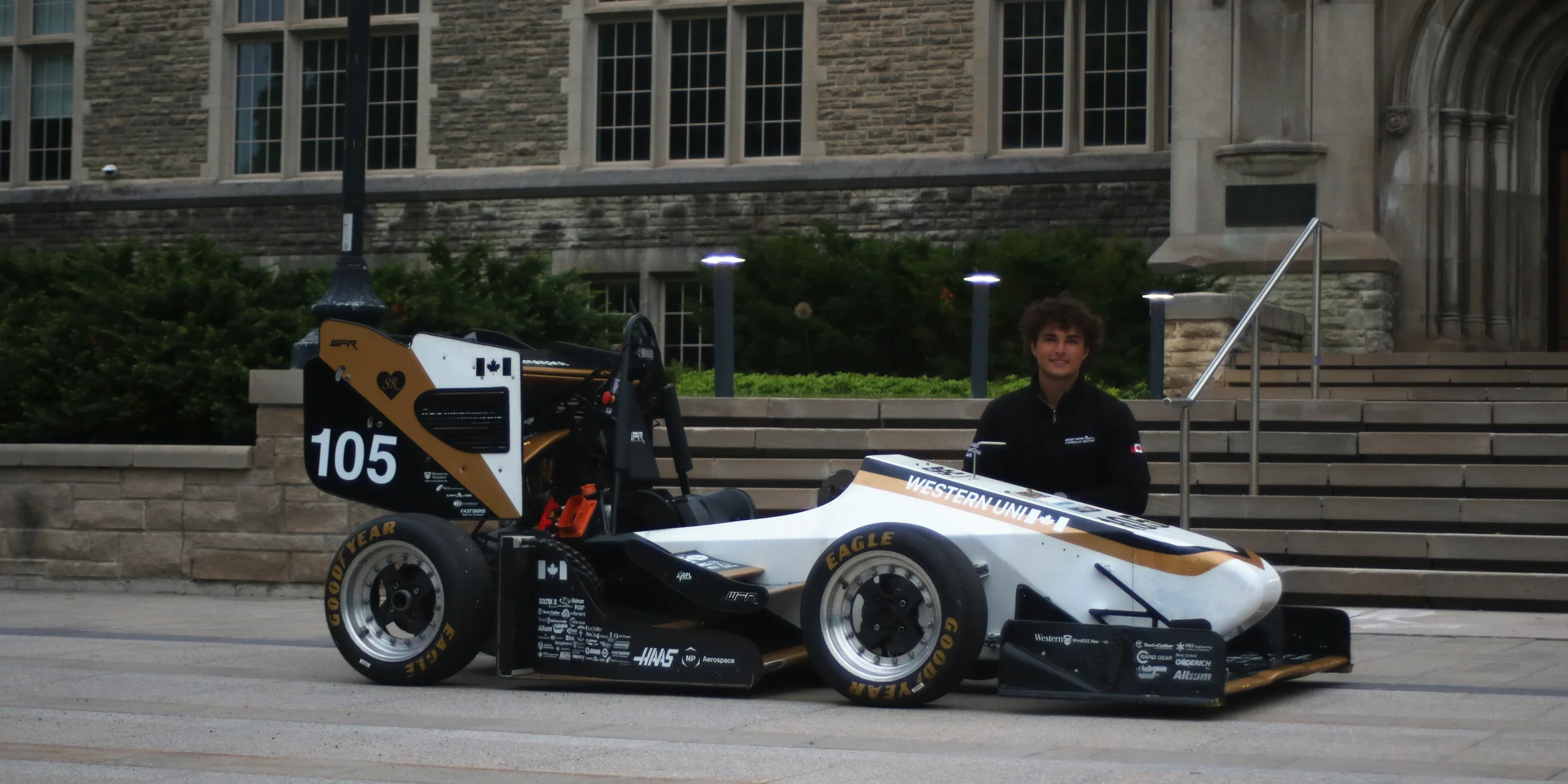
A Formula SAE car is not a set of parts bolted together: every decision in one subsystem shows up as a constraint in the others.
420 V
peak pack voltage, five modules in series
CL 1.8
lift coefficient, Ford's DTF Wind Tunnel
Emrax 228 MV
single motor, driving the rear wheels
Subsystem 01 of 13
Aerodynamics
A multi-element package of nosecone, front wing, side wings, rear wing and diffuser, built in-house with carbon fibre/glass composites and Rohacell foam core internal structures.
Budgeting, sponsorship, marketing, cost reports and project management, driven by Engineering and Ivey Business students working side by side. Business Development also prepares the cost and business case events at competition.
A full carbon fibre monocoque with a planar design, infused and cured in a single stage. It carries every other subsystem and sets the suspension and drivetrain geometry; for WFR26-E it was refined for rules compliance, rear stiffness and a faster build.
One shared coolant loop keeps the motor and inverter inside their temperature limits over a full endurance run. For WFR26-E the system was overhauled: every component was bench tested for pressure drop and a larger pump was fitted.
Data Acquisition works with every technical subsystem to collect, store and analyse vehicle data. For WFR26-E it moved telemetry from LTE to a 5 GHz radio link and built tools so anyone on the team can use the data.
A single Emrax 228 MV motor and a Cascadia Motion CM200DZ inverter drive the rear wheels through the team's custom double-reduction gearbox and a Drexler limited slip differential. For WFR26-E the gearbox carried over, with its worn gears remanufactured.
The driver interface: the carbon seat, padding, headrest and cockpit layout. For WFR26-E the cockpit was sized from the 5th percentile female to the 95th percentile male, with modular padding made from the team's own driver measurements.
Steering turns the driver's input into wheel angle and carries feel back to the driver. On WFR26-E it is an evolution of the 2025 system, with a shorter steer arm, a quicker ratio and a steering angle sensor so handling can be measured.
Vehicle is the team's whole-car group: it links competition points targets to lap-time simulation and sets the performance targets each subsystem designs to.